


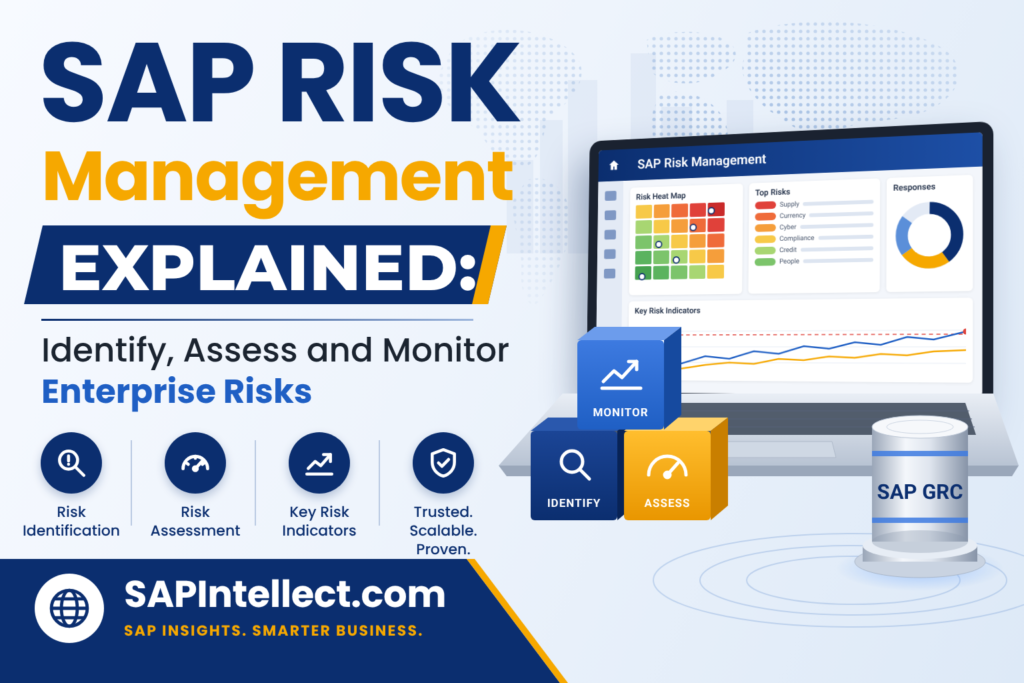
Every business faces risks, from supply disruptions to currency swings and cyber threats. SAP Risk Management helps companies identify and manage them systematically as part of SAP Governance, Risk and Compliance.
Quick answer: SAP Risk Management is the SAP GRC solution for enterprise risk management (ERM). It helps organizations identify risks, assess their likelihood and impact, define responses, monitor key risk indicators (KRIs) and report risk exposure to management and the board, all in one structured framework.
Key takeaways
- Follows a clear risk lifecycle: identify, assess, respond, monitor.
- Uses heat maps to show likelihood and impact.
- KRIs give early warnings based on real data.
- Links risks to business objectives and owners.
What Is SAP Risk Management?
SAP Risk Management gives risk managers and business owners a common platform to document risks, agree responses and track whether exposure is within the company’s risk appetite.
How Does the Risk Management Process Work?
- Risk planning: set objectives, risk categories and appetite.
- Risk identification: record risks with owners and drivers.
- Risk analysis: assess likelihood and impact.
- Risk response: accept, reduce, transfer or avoid.
- Monitoring: track KRIs, surveys and incidents.
What Are the Main Features?
| Feature | Benefit |
| Risk register | Single list of all enterprise risks |
| Risk assessments and surveys | Consistent scoring across units |
| Heat maps and dashboards | Clear view of top risks |
| Key risk indicators | Early warning from business data |
| Loss event tracking | Learn from incidents that happened |
Risk Management vs Process Control vs Access Control
| Solution | Main focus |
| SAP Risk Management | Enterprise risks and responses |
| SAP Process Control | Internal controls and compliance testing |
| SAP Access Control | User access and SoD risks |
What Are the Four Risk Response Strategies?
| Strategy | Meaning | Example |
| Avoid | Stop the activity causing the risk | Exit an unstable market |
| Reduce | Lower likelihood or impact | Add a second supplier |
| Transfer | Shift the risk to another party | Buy insurance or hedge currency |
| Accept | Take the risk knowingly | Minor risks within appetite |
How Do Heat Maps Work?
A risk heat map is a grid with likelihood on one axis and impact on the other. Each risk appears as a dot in a colored cell: green for low, yellow for medium and red for high. Management can see at a glance which risks need attention. SAP Risk Management shows both inherent risk (before controls) and residual risk (after responses), so leaders can judge whether actions are working.
What Are Examples of Key Risk Indicators?
- Supply risk: percentage of late supplier deliveries.
- Financial risk: overdue receivables or currency exposure.
- Operational risk: unplanned machine downtime from SAP PM.
- People risk: employee turnover in critical roles.
- Compliance risk: number of open audit findings.
KRIs can be fed automatically from SAP data, and thresholds trigger alerts when a value moves into the warning zone.
A Simple Real-World Example
An electronics company depends on one supplier for a critical chip. In SAP Risk Management, the risk is rated high likelihood and high impact. The response is to qualify a second supplier and increase safety stock. A KRI tracks the supplier’s on-time delivery rate. When delays rise above the threshold, an alert reaches the supply chain director, who activates the second supplier before production is affected. The residual risk on the heat map moves from red to yellow.
What Are Common Mistakes?
- Treating ERM as a yearly exercise: risks change constantly.
- Vague risk descriptions: clear cause-event-impact statements work better.
- No link to controls: connect responses with SAP Process Control where possible.
Practical Tips From Real Projects
- Keep the risk taxonomy simple so business users can apply it.
- Assign a named owner to every risk and response.
- Use a few meaningful KRIs instead of many noisy ones.
Frequently Asked Questions
What is SAP Risk Management used for?
It is used to identify, assess, respond to and monitor enterprise risks in a structured, company-wide framework.
What is a key risk indicator (KRI)?
A KRI is a measurable value, such as supplier delivery delays, that signals when a risk is increasing.
Is SAP Risk Management part of SAP GRC?
Yes. It is one of the SAP GRC solutions, alongside SAP Access Control and SAP Process Control.
What is the difference between inherent and residual risk?
Inherent risk is the level of risk before any controls or responses are applied. Residual risk is what remains after responses. Comparing both shows whether risk management actions are actually working.
What is risk appetite?
Risk appetite is the amount and type of risk an organization is willing to accept to reach its goals. It helps managers decide which risks to accept and which ones need further responses.
Which frameworks does SAP Risk Management support?
SAP Risk Management is flexible enough to support common enterprise risk frameworks such as COSO ERM and ISO 31000. Companies configure risk categories, scoring scales and workflows to match their chosen framework.
Key SAP Risk Management Terms at a Glance
| Term | Meaning |
| Risk appetite | Level of risk the company is willing to accept |
| Risk driver | Cause that can trigger a risk |
| Inherent risk | Risk level before responses |
| Residual risk | Risk level after responses |
| Key risk indicator (KRI) | Metric warning of rising risk |
| Loss event | Actual incident that caused a loss |
How Can You Start Learning SAP Risk Management?
- Learn ERM frameworks: such as COSO ERM and ISO 31000.
- Understand the risk lifecycle: identify, assess, respond and monitor.
- Practice assessments: likelihood, impact and heat maps.
- Study KRIs: defining thresholds and data sources.
- Explore GRC integration: links with Access Control and Process Control.
Who Uses SAP Risk Management?
- Chief risk officers leading enterprise risk management.
- Business unit managers owning their risks.
- Boards and audit committees reviewing top risks.
- Regulated industries such as banking, insurance and energy.
Final Thoughts
SAP Risk Management helps companies move from reacting to surprises to managing risk proactively, with clear ownership and data-driven early warnings.
Sources and further reading: SAP Help Portal · SAP Learning
Written by the SAP Intellect editorial team. Last reviewed: November 2026.