


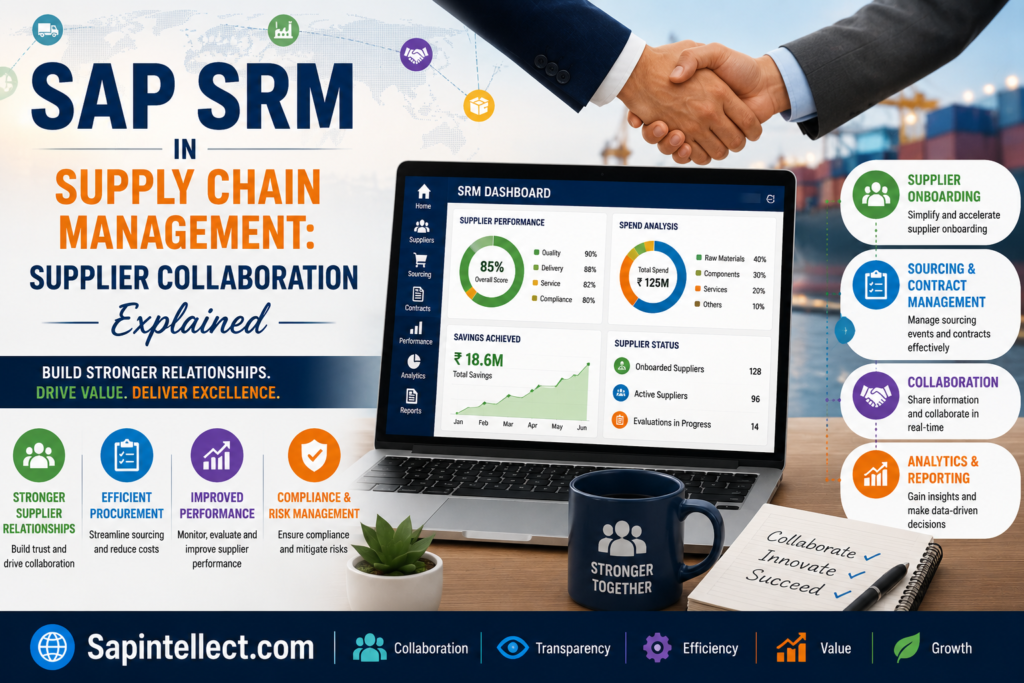
A supply chain is only as strong as its suppliers. SAP Supplier Relationship Management (SRM) connects buyers and suppliers so that goods arrive on time, at the right price. This article looks at SRM from a supply chain point of view. For the full product overview, see our complete guide to SAP SRM.
Quick answer: In SAP Supply Chain Management, SAP SRM handles the supplier side of the chain. It supports self-service purchasing, sourcing, contract management and supplier collaboration such as order confirmations and invoices through a supplier portal. SAP’s strategic successors are SAP Ariba and procurement functions in SAP S/4HANA.
Key takeaways
- SRM links internal demand with external suppliers.
- Supplier collaboration improves visibility of confirmations and deliveries.
- Contracts and sourcing reduce costs and supply risk.
- New projects usually use SAP Ariba or S/4HANA Procurement.
What Role Does SRM Play in the Supply Chain?
Supply chain planning decides what is needed and when. SRM makes sure suppliers can deliver it: it turns requirements into purchase orders, shares them with suppliers and tracks their responses.
What Are the Main SRM Capabilities?
| Capability | Supply chain benefit |
| Self-service procurement | Fast, controlled purchasing by employees |
| Sourcing and bidding | Best supplier and price for each requirement |
| Contract management | Stable prices and terms |
| Supplier self-services | Order confirmations, ASNs and invoices online |
| Supplier evaluation | Data-driven supplier performance reviews |
How Does SRM Connect With Other SAP Solutions?
Purchase orders and goods receipts post in SAP MM, deliveries are received in SAP EWM, and invoices flow to finance.
SAP SRM vs SAP Ariba
| SAP SRM | SAP Ariba | |
| Deployment | On-premise | Cloud |
| Supplier network | Company-specific portal | Global Ariba Network |
| Strategic direction | Legacy | SAP’s strategic procurement cloud |
Check SAP’s current maintenance announcements for SRM support dates.
How Does the SRM Purchasing Process Work Step by Step?
- Shopping cart: an employee selects items from a catalog or describes a need.
- Approval: workflow routes the cart to managers based on value and category.
- Sourcing: if no contract exists, buyers run a bid invitation or RFx.
- Purchase order: the PO is created and sent to the supplier.
- Supplier confirmation: the supplier confirms dates and quantities in the supplier portal.
- Confirmation and invoice: receipt is confirmed and the invoice is matched for payment.
What Are SRM Deployment Scenarios?
| Scenario | How it works |
| Classic | Purchase orders are created in the ERP back end |
| Extended classic | POs are created in SRM and copied to ERP |
| Standalone | Procurement runs fully in SRM, only finance in ERP |
| Decoupled | A mix of scenarios by product category |
Which Supplier KPIs Matter for the Supply Chain?
| KPI | Why it matters |
| On-time delivery | Late supply stops production |
| Quality rejection rate | Defects create rework and risk |
| PO confirmation rate | Shows supplier reliability early |
| Price variance | Shows contract compliance |
A Simple Real-World Example
An automotive supplier depends on hundreds of component suppliers. With SRM supplier self-services, suppliers confirm each purchase order and send advance shipping notices online. Planners see confirmations within hours instead of chasing suppliers by phone, and receiving teams know what will arrive each day. Supplier evaluation combines delivery and quality data, helping procurement reward reliable suppliers with more business.
How Should Companies Plan the Move From SRM?
- Map current SRM processes and decide which belong in S/4HANA and which in SAP Ariba.
- Move operational buying to S/4HANA Procurement and supplier collaboration to the Ariba Network.
- Migrate active contracts and catalogs first, as they drive most savings.
- Communicate early with suppliers about new portals and processes.
Practical Tips From Real Projects
- Onboard key suppliers first; they create most of the value.
- Keep supplier master data clean and shared across systems.
- Track supplier confirmation rates as a supply chain KPI.
Frequently Asked Questions
What is SAP SRM used for in supply chain management?
It manages the supplier side of the supply chain, including purchasing, sourcing, contracts and supplier collaboration.
Is SAP SRM still supported?
SAP SRM is a legacy on-premise product. SAP Ariba and S/4HANA procurement are the strategic successors; check SAP’s maintenance dates.
How does SRM integrate with SAP ERP?
Purchase orders, goods receipts and invoices created through SRM are posted in SAP ERP, mainly in MM and finance.
What is a shopping cart in SAP SRM?
A shopping cart is an employee’s request for goods or services, often created from a catalog. After approval, it becomes a purchase order or is passed to a buyer for sourcing.
What are SRM deployment scenarios?
SRM supports classic, extended classic, standalone and decoupled scenarios. They define where purchase orders are created, in the ERP back end or in SRM itself, and how documents flow between the systems.
What is supplier self-service in SAP SRM?
Supplier self-service is a portal where suppliers receive purchase orders, send confirmations and advance shipping notices, and create invoices. It reduces manual communication and gives buyers faster visibility of supplier responses.
Key SAP SRM Terms at a Glance
| Term | Meaning |
| Shopping cart | Employee request for goods or services |
| RFx / bid invitation | Request for quotation, proposal or information |
| Central contract | Contract used across several purchasing systems |
| Supplier self-services (SUS) | Portal where suppliers process orders and invoices |
| Catalog | Approved products and prices for self-service buying |
| Supplier evaluation | Rating supplier performance |
How Can You Build Skills for Supplier Management?
- Learn procurement basics: sourcing, contracts and procure-to-pay.
- Understand SAP MM: the ERP foundation behind SRM.
- Study SRM concepts: shopping carts, scenarios and supplier collaboration.
- Move to SAP Ariba: the strategic cloud procurement suite.
- Learn S/4HANA Procurement: central procurement and flexible workflow.
Who Benefits From Strong Supplier Collaboration?
- Manufacturers with just-in-time supply.
- Retailers with many suppliers and frequent orders.
- Public sector organizations with strict tender rules.
- Procurement teams aiming for savings and lower risk.
Final Thoughts
SAP SRM brings suppliers into the supply chain process. Understanding it helps companies plan their move to SAP Ariba and S/4HANA while keeping strong supplier relationships.
Sources and further reading: SAP Help Portal · SAP Learning
Written by the SAP Intellect editorial team. Last reviewed: November 2026.