SAP EHS (Environment, Health and Safety) Explained: Features and Benefits
Keeping people safe and meeting environmental regulations is a legal duty and a business priority. SAP Environment, Health and Safety (EHS) supports these goals and is part of SAP Product Lifecycle Management.
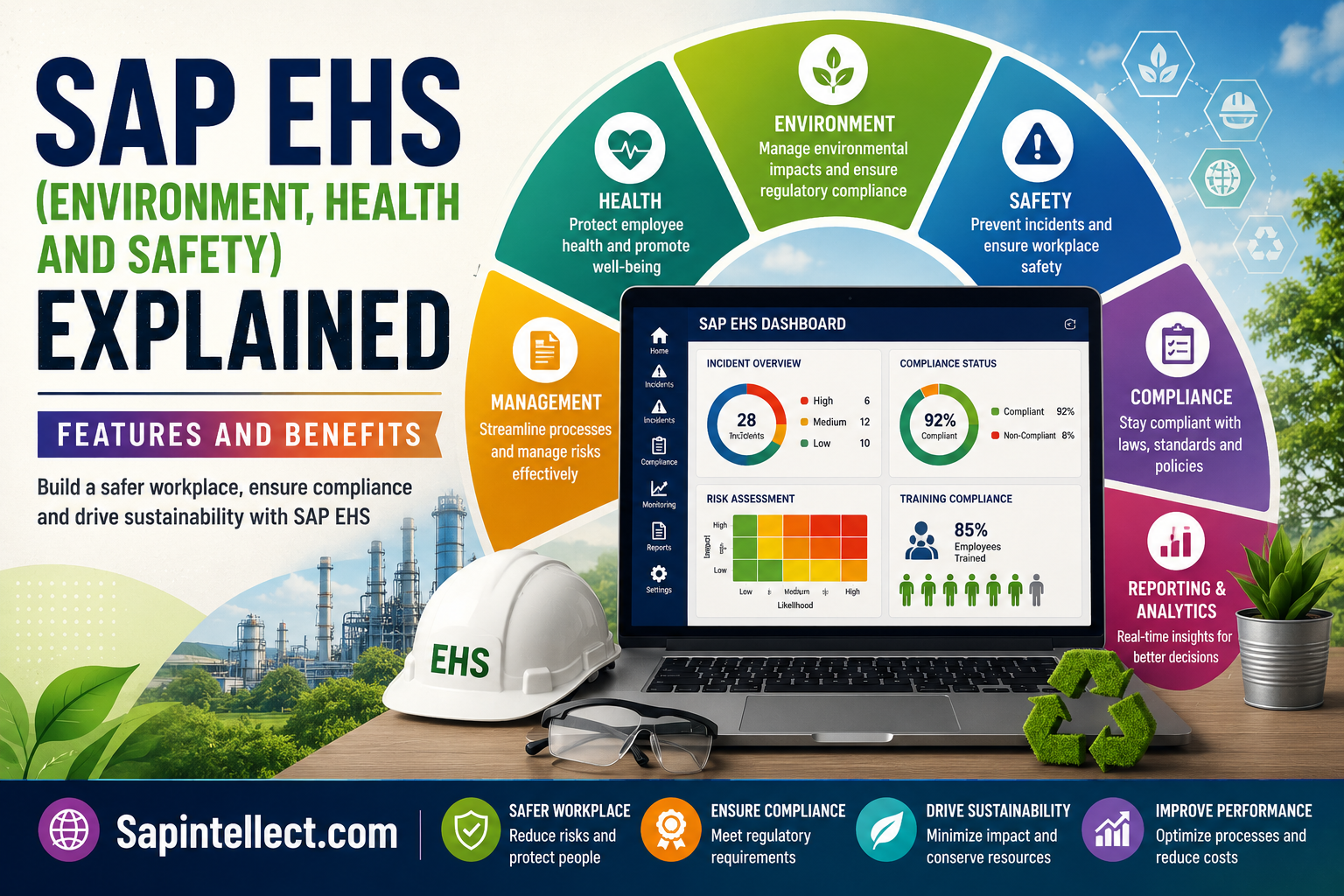
Quick answer: SAP EHS (Environment, Health and Safety) is SAP’s solution for managing workplace safety, occupational health, environmental compliance and product safety. It covers incident management, risk assessment, emissions management, safety data sheets and dangerous goods. In SAP S/4HANA, these features are delivered as SAP EHS and SAP Product Compliance.
Key takeaways
- Records and investigates incidents and near misses.
- Identifies hazards and assesses risks at workplaces.
- Tracks emissions and environmental permits.
- Supports product compliance such as safety data sheets.
What Is SAP EHS?
SAP EHS gives companies one place to manage safety and environmental processes, so they can prevent incidents, protect employees and prove compliance to authorities.
What Are the Main Components?
| Component | Purpose |
| Incident management | Record, investigate and follow up incidents |
| Health and safety management | Risk assessments, controls and safety instructions |
| Environment management | Emissions, permits and compliance scenarios |
| Product compliance | Safety data sheets, labels and substance regulations |
| Dangerous goods management | Rules for transporting hazardous goods |
Classic EHS vs EHS in S/4HANA
| Classic SAP EHS | S/4HANA EHS | |
| User interface | SAP GUI | SAP Fiori apps |
| Product safety | EHS Product Safety | SAP Product Compliance |
| Mobile incident reporting | Limited | Supported |
How Does EHS Integrate With Other SAP Processes?
EHS connects with SAP PM for safe maintenance work, with SAP HCM for employee data and with product data for substance information.
How Does Incident Management Work Step by Step?
- Report: any employee reports an incident, near miss or safety observation, often from a mobile device.
- Initial assessment: the safety team checks severity and whether authorities must be informed.
- Investigation: root causes are analyzed, for example with the “5 whys” method.
- Actions: corrective and preventive actions are assigned with owners and due dates.
- Reporting: legal reports and internal KPIs are generated.
- Close: the incident is closed once all actions are complete and effective.
How Does Risk Assessment Work?
In health and safety management, companies identify hazards for each location, job or activity, for example noise, chemicals or working at height. Each hazard is rated by likelihood and severity using a risk matrix. Controls such as guards, protective equipment or training are defined to reduce the risk. SAP EHS documents all of this and reminds teams when assessments must be reviewed, which helps companies meet occupational safety rules.
Which Safety and Environmental KPIs Matter?
| KPI | What it shows |
| Lost time injury frequency rate (LTIFR) | Injuries causing lost work time per hours worked |
| Near miss reporting rate | Strength of the safety culture |
| Open corrective actions | Follow-through on improvements |
| Emissions vs. permit limits | Environmental compliance |
A Simple Real-World Example
A chemical plant asks workers to report near misses using a mobile app. A worker reports a slippery floor near a loading area. The safety team investigates, finds a leaking valve, and creates actions: repair the valve through SAP PM and add anti-slip mats. Months later, the dashboards show near-miss reports rising while injuries fall, a sign that hazards are being found and fixed before people get hurt.
What Are Common Mistakes?
- Complicated reporting forms: employees stop reporting.
- No follow-up on actions: incidents repeat.
- Siloed data: safety, maintenance and HR data should be connected.
Practical Tips From Real Projects
- Make incident reporting easy on mobile; reporting rates rise quickly.
- Agree on a common risk matrix across sites before go-live.
- Keep regulatory content updated for each country you operate in.
Frequently Asked Questions
What is SAP EHS used for?
SAP EHS is used to manage workplace safety, incidents, risk assessments, environmental compliance and product safety.
Is SAP EHS available in S/4HANA?
Yes. SAP S/4HANA includes EHS features such as incident management, health and safety management and environment management, plus SAP Product Compliance.
Does SAP EHS create safety data sheets?
Yes. Product safety and compliance features support creating and distributing safety data sheets and labels.
What is the difference between an incident and a near miss?
An incident is an event that caused injury, illness, damage or environmental harm. A near miss is an event that could have caused harm but did not. Reporting near misses helps companies fix hazards before real incidents happen.
What is SAP Product Compliance?
SAP Product Compliance is the S/4HANA solution for managing product safety and regulatory requirements. It supports substance data, safety data sheets, labeling, dangerous goods and checks against chemical regulations in different countries.
Can employees report incidents on mobile devices?
Yes. SAP EHS in S/4HANA offers Fiori apps that let employees report incidents, near misses and safety observations from mobile devices, often with photos and location data, making reporting faster and easier.
Key SAP EHS Terms at a Glance
| Term | Meaning |
| Incident | Unplanned event causing or risking harm |
| Near miss | Event that could have caused harm but did not |
| Hazard | Source of potential harm |
| Risk assessment | Evaluation of likelihood and severity of hazards |
| Safety data sheet (SDS) | Document describing hazards of a substance |
| Compliance scenario | Set of environmental obligations for a facility |
How Can You Start Learning SAP EHS?
- Learn EHS basics: occupational safety, environmental rules and product safety.
- Understand the data model: locations, hazards, substances and incidents.
- Practice incident management: report, investigate and close an incident.
- Study risk assessment: hazards, controls and reviews.
- Explore product compliance: SDS creation and substance regulations.
Which Industries Use SAP EHS Most?
- Chemicals and pharmaceuticals: hazardous substances and strict regulations.
- Oil, gas and mining: high-risk operations.
- Manufacturing: worker safety on the shop floor.
- Utilities: environmental permits and emissions reporting.
Final Thoughts
SAP EHS helps companies protect people and the environment while staying compliant, turning safety from paperwork into a managed, measurable process.
Sources and further reading: SAP Help Portal · SAP Learning
Written by the SAP Intellect editorial team. Last reviewed: November 2026.
Discover more from SAP Intellect
Subscribe to get the latest posts sent to your email.