SAP PPM (Portfolio and Project Management) Explained: Features and Use Cases
Companies always have more project ideas than budget and people. SAP Portfolio and Project Management (PPM) helps them choose the right projects and deliver them well. It is part of SAP Product Lifecycle Management.
Quick answer: SAP PPM (Portfolio and Project Management) is SAP’s solution for managing project portfolios and project execution. Portfolio management evaluates, prioritizes and monitors projects against strategy and budget, while project management plans phases, tasks, resources and documents. It is often used for R&D, IT and product development projects.
Key takeaways
- Portfolio management helps pick the projects that deliver the most value.
- Project management plans phases, tasks and resources.
- Integrates with SAP PS and finance for costs.
- Available in SAP S/4HANA as Portfolio and Project Management.
What Is SAP PPM?
SAP PPM combines strategic portfolio decisions with operational project planning, giving leaders a clear view of all projects, their costs, risks and status.
What Are the Main Components?
| Component | Purpose |
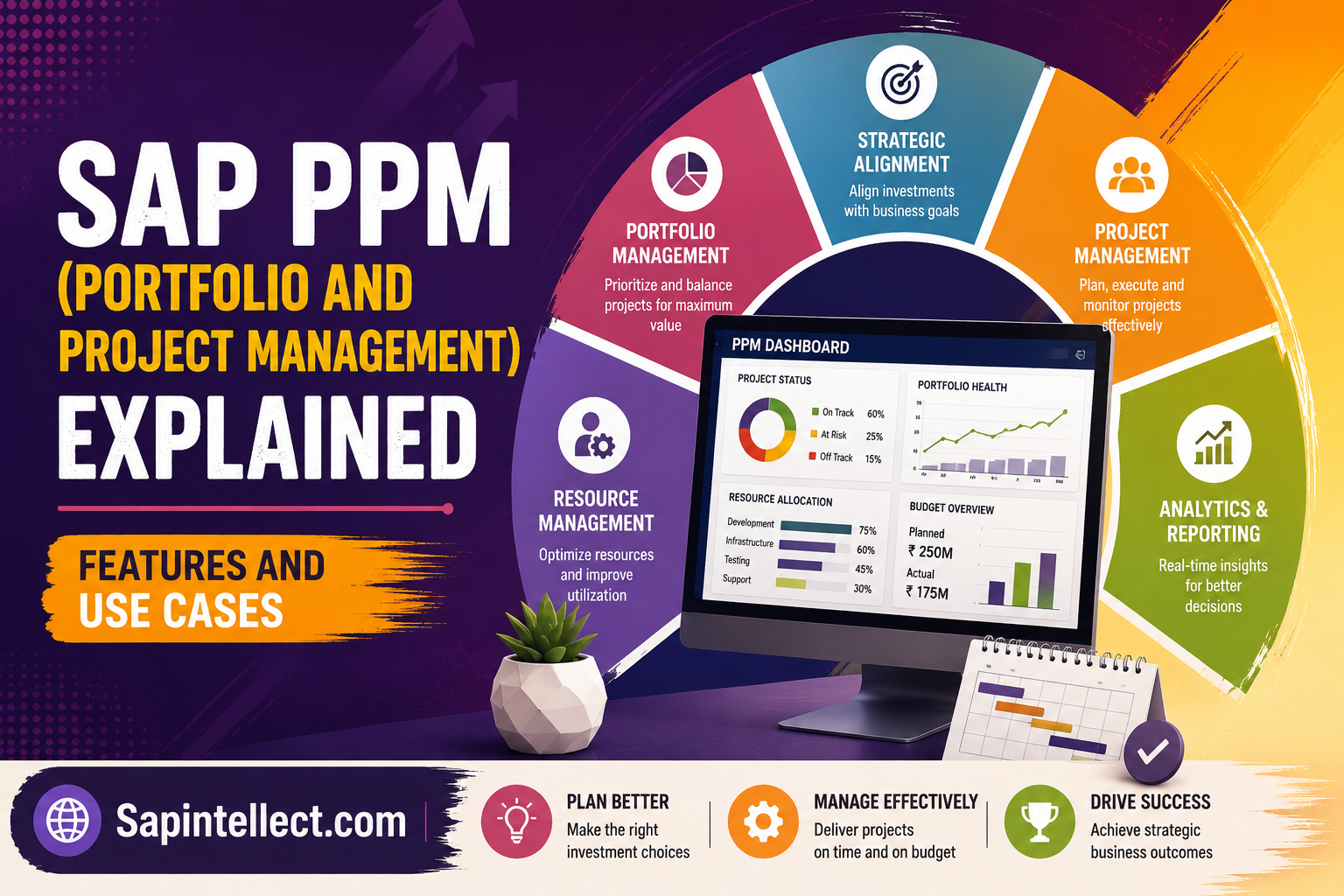
| Portfolio management | Evaluate, score and prioritize projects and ideas |
| Project management | Phases, tasks, checklists and milestones |
| Resource management | Assign people and capacity to projects |
| Financial planning | Budgets and costs per project and portfolio |
| Dashboards | Status, risks and KPIs at a glance |
SAP PPM vs SAP PS
| SAP PPM | SAP PS | |
| Focus | Portfolio decisions and project planning | Project execution, costs and logistics |
| Typical projects | R&D, IT, product development | Engineering, construction, capital projects |
| Finance depth | Planning level | Detailed costs, budgets and settlement |
Many companies combine both: PPM for portfolio and planning, PS for detailed execution and accounting.
How Does PPM Support Product Development?
New product projects can follow a stage-gate process in PPM, with decision points at each phase. Product information is managed in SAP Product Data Management, linking projects with the products they create.
How Does Portfolio Management Work Step by Step?
- Collect ideas: new project proposals are submitted with goals, costs and benefits.
- Score: each proposal is rated on strategic fit, value, risk and cost.
- Prioritize: proposals are ranked and compared with the available budget and capacity.
- Approve: a review board approves, rejects or postpones items.
- Execute: approved items become projects in project management or SAP PS.
- Monitor: progress, costs and benefits are reviewed regularly, and weak projects are stopped early.
What Is a Stage-Gate Process?
A stage-gate process splits a project into phases (stages) separated by decision points (gates). At each gate, a review board checks results against criteria and decides whether to continue, change or stop the project. In product development, typical stages are idea, concept, development, testing and launch. SAP PPM supports this with phases, checklists, approvals and decision documents.
Which Portfolio KPIs Matter?
| KPI | What it shows |
| Budget vs. actual | Financial control of projects |
| Schedule variance | Whether projects are on time |
| Resource utilization | Overloaded or idle teams |
| Strategic alignment | Spending on strategic priorities |
| Expected value / ROI | Return on the project portfolio |
A Simple Real-World Example
A consumer goods company receives 60 new product ideas each year but can only fund 15. With SAP PPM, every idea is scored on market potential, cost and strategic fit. The review board compares the portfolio against budget and R&D capacity and approves the best 15. Each project follows a stage-gate process. Two projects fail their test-market gate and are stopped early, freeing budget for a promising new idea instead of wasting money on launches that would not succeed.
What Are Common Mistakes?
- Approving too many projects: overloaded teams deliver everything late.
- No gate discipline: projects continue even when they should stop.
- Disconnected finance: integrate actual costs from SAP CO for reliable reporting.
Practical Tips From Real Projects
- Agree on simple, consistent scoring criteria for projects.
- Keep resource data current, or capacity planning loses value.
- Use project templates to standardize phases and checklists.
Frequently Asked Questions
What is SAP PPM used for?
SAP PPM is used to evaluate and prioritize project portfolios and to plan and track projects, resources and budgets.
What is the difference between SAP PPM and SAP PS?
SAP PPM focuses on portfolio decisions and project planning, while SAP PS focuses on detailed project execution, costs and logistics.
Is SAP PPM available in S/4HANA?
Yes. SAP S/4HANA offers portfolio and project management capabilities, with Fiori apps for planning and monitoring.
What is a stage-gate process?
A stage-gate process divides a project into stages separated by decision gates. At each gate, a review board checks results and decides to continue, change or stop the project, which prevents money being spent on weak ideas.
How does SAP PPM help with resource management?
SAP PPM lets project managers request roles and skills, and resource managers assign people. Capacity views show where teams are overloaded or underused, helping leaders plan realistic project timelines.
Can SAP PPM be used for IT projects?
Yes. Many IT departments use SAP PPM to collect demands, prioritize IT projects against budget and capacity, and track progress and costs across the IT portfolio.
Key SAP PPM Terms at a Glance
| Term | Meaning |
| Portfolio | Collection of projects managed together |
| Bucket | Grouping in a portfolio, such as a business unit or strategy |
| Item | Proposal or project in the portfolio |
| Decision point | Gate where projects are approved or stopped |
| Phase | Stage of a project, such as concept or development |
| Role | Required skill in resource planning |
How Can You Start Learning SAP PPM?
- Learn portfolio management basics: scoring, prioritization and gates.
- Understand the structure: portfolios, buckets and items.
- Practice project planning: phases, tasks and checklists.
- Study resource management: roles, staffing and capacity.
- Explore integration: SAP PS and financial data from CO.
Who Uses SAP PPM?
- R&D organizations managing product development pipelines.
- IT departments prioritizing IT projects and demands.
- PMOs overseeing many projects.
- Executives aligning investments with strategy.
Final Thoughts
SAP PPM helps companies invest in the right projects and deliver them with clear visibility of costs, resources and progress.
Sources and further reading: SAP Help Portal · SAP Learning
Written by the SAP Intellect editorial team. Last reviewed: November 2026.
Discover more from SAP Intellect
Subscribe to get the latest posts sent to your email.